Ted Hughes’s Swallows.
© Ann Skea 2026
Ted Hughes Society Podcast (June 28, 2025) https://shows.acast.com/the-ted-hughes-society-podcast/episodes/ann-skea-ted-hughess-swallows
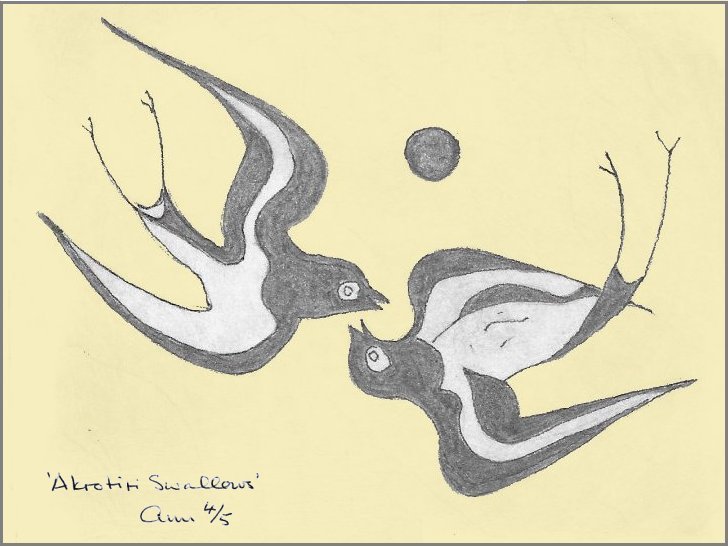
Ted Hughes Society Podcast (June 28, 2025) https://shows.acast.com/the-ted-hughes-society-podcast/episodes/ann-skea-ted-hughess-swallows
Of all Ted’s birds, Crow is justifiably the most famous, but I want to talk about his swallows.
I have a small bench–top etching press that I don’t use very often, because I have to clean our garage in order to set it up with the water–baths, chemicals and inks etc. So I collect images from all sorts of different places which I think will inspire me to do that.
Recently, I found pictures of swallows that had been painted on a frescoed wall in a Villa in Akrotiri, on the Greek island of Santorini. Akrotiri was buried by volcanic ash in about 1600 BCE, but these swallows, apparently playing together in the wind, survived. They are so full of energy and delight that they make me think of the swallow in Ted’s poem of that name – with her ‘compass–tremor tail needles’, and the way she is ‘flung taut on her leash’ – ‘water’skiing a wind’. (THCP 604).
The farmer’s wife, too, in Ted’s fable What is the Truth, loves the way swallows suddenly appear ‘swimming’ in a ‘slattery April blow’, ‘pinned on a roller of air’ and how you first glimpse them from the corner of your eye ‘like a mote in the wind–smart’. (THCP 634–5).
The Vicar in What is the Truth is less enamoured of swallows. He sees them as ‘aristocrats’, but he also sees ‘something sinister about them’. They remind him of a jet–engine, of aircraft and wars, although he can see that that they have ‘solved the problem… of the harpoon’.
Ted, as a lifelong collector of myth and folk–lore from around the world, would have known of the Greeks’ love of swallows. And he would probably have know the Rhodes Swallow Song, which for centuries has been sung in a spring festival in which a caged swallow (generally just a model of one) is paraded from house–to–house by masked children singing
The swallow is here, the new year he brings,
As he lengthens the days with the beat of his wings.
White and black
Are his belly and back.
Pay his tribute once more
With cheese in its basket
And port from your store
And wine from its flasket
And egg from your casket, and bread
When we ask it.
A similar custom has been, and still is, observed close to the winter solstice in parts of England, Ireland and Wales, when the wren, ‘King of the Birds’ is hunted and killed so that the Robin, the ‘new Sun’, the ‘Oak King of Summer’, can begin nature’s renewal. The Wren Boys, carry a caged wren (these days it is a model) and go from house to house singing:
We’ll hunt the wren, Said Robin–a–bobbin,
We’ll hunt the Wren, said Richie to Robin,
We’ll hunt the Wren , said Jack–o–the–land,
We’ll hunt the Wren said everyone.
The Wren is found ‘in yonder green bush’ and on St Steven’s day, December 26th, it ‘is caught in the furze’. The song ends:
Although he is little, his family is great,
I pray you, good dame, do give us a treat.
To go back to Ted’s swallows: in his poem ‘Swallows 1’. in the Collected Poems for Children, (THPC 153–5) the birds are ‘the truest, bluest blade–metal / Whetted on air’. And in ‘Swallows 4’ their airy flight is like ‘a foreign sort of sky–writing’
It is noticeable that nearly all of Ted’s swallows are female and that, although there may be ‘heat wave’ and ‘thunder’, his swallows are always linked to the air or the wind (or in the Vicar’s case to jet aircraft).
Swallows are, of course, traditional harbingers of Spring and of renewal in nature. In this, they are like the Goddess Isis, who Robert Graves’ in The White Goddess, called ‘The Goddess of the turning year’, and who in Egyptian mythology took the form of a swallow and used her wings to fan life back into the body of Osiris; and she breathed her song into his mouth to give him breath.
In his book Egyptian Magic, the Egyptologist Wallis Budge writes that ‘12 chapters of The Book of the Dead are devoted to providing the deceased with the words of power, the recital of which was necessary to enable him to assume the form of a ‘hawk of gold’ or ‘a swallow’. (pp 230–1).
And in Wallis Budge’s translation of The Book of the Dead, a copy of which Ted had in his Library, he writes that the ‘Rubric’ of the 86th Chapter declares that if these words ‘are know by the deceased’
He shall come forth by day and shall not be turned back at any gate in the Underworld, and that shall be his transformation into a swallow regularly and continually
In the opening words, the deceased is made to say:
“I am a swallow, I am a swallow, I am the Scorpion, the daughter of Ra.” (Budge.The Gods of the Egyptians I p.373).
The Scorpion Goddess, Serqet, was also known as ‘she who gives breath’, and the scorpion was sacred to Isis.
One more swallow appears in Ted’s work – in ‘Tereus and Philomela’ in Tales From Ovid. This swallow is very different to his others but, like the deceased in Egyptian mythology, it takes wing from a human body.
In 1993, Ted contributed four translations of tales from Ovid’s Metamorphoses to After Ovid, edited by Michael Hoffman and James Lasdun. He told Keith Sagar that he had enjoyed writing these so much that in 1996 he produced twenty–one more. And In a letter to me in September of that year, he wrote: ‘I also did 25 tales from Ovid’s Metamorphoses – enjoyed that. A holiday in a rest home!!’
Ovid drew on many older sources of myth and legend for his Metamorphoses, and the horrific story of Tereus and Philomela was already well–known. Perhaps Ted’s Vicar in What is the Truth was remembering this story when he called swallows ‘aristocratic’ and ‘sinister’.
Briefly, the Thracian King, Tereus, marries Procne, the daughter of King Pandion of Athens. In Thrace, Procne misses her younger sister, Philomela, so much that she persuades Tereus to go to Athens and plead with her father to let Philomela visit her. Which he does. On the way back to Thrace, Tereus rapes Philomela, and to stop her telling anyone of this he cuts out her tongue and imprisons her in a castle in the woods. Philomela weaves a tapestry telling of her plight and a trusted servant takes it to Procne, who devises a way to rescue Philomela and secretly take her back with her to Tereus’s palace. Together the furious women plot revenge. Procne, in a mad rage, kills her son, Itys, and they cut up his body and serve it to Tereus in a pie. Then Philomela confronts him with Itys’s head, and they tell him what he has eaten. He, in grief and fury, pursues them with his sword, but all three turn into birds. Tereus becomes a hoopoe, and the sisters into a swallow and a nightingale. Versions of the story differ, however, as to which sister is the swallow and which the nightingale.
Ted is quite clear about this:
Philomela
Mourned in the forest, a nightingale
Procne
Lamented round and round the palace,
A swallow.
Among the Ancient Greeks, Homer reverses this: in chapter 19 of The Odyssey, Penelope likens her swarming anxieties to those of Procne, ‘Pandereo’s daughter, the green wood nightingale’ who killed ‘her own beloved child’: and in his Works and Days, he writes that Philomela, ‘the shrilly wailing daughter of Pandion, the swallow, appears to men when spring is just beginning’.
Sophocles, in a surviving fragment of his lost play Tereus, also has Philomela as the swallow. So, too, in his Odes, 10 and 21, does the Greek poet Anacreon, who, apparently, was famous for his drinking songs. Although this is too grim a story for a drinking song.
Ovid himself, if the literal translations we have are correct, wisely did not assign a particular bird to either woman, but wrote that Tereus – ‘drawing his sword’
was rushing in pursuit of Pandion’s daughters, when it seemed that the girls bodies were hovering in the air, raised up on wings; in fact, they were hovering on wings. One of them flew off into the woods, the other flew under the eaves of the roof.
However, Ovid does add that ‘traces of murder were still visible on her breast and her feathers were still crimson with blood’, and since the nightingale is a rather drab, brown bird with only reddish feather in its tail, this does suggest that it was Procne who became the swallow.
Since Ovid‘s time, many other poets have relied on his work and most seem to have accepted accepted this. T.S.Eliot borrowed phrases from the Elizabethan dramatist John Lyly’s version of Tereus and Philomela when in, ‘The Fire Sermon’ in The Waste Land, he made Philomela the nightingale – ‘filling all the desert with inviolable voice’, crying ‘Jug Jug to dirty ears’. And in ‘The Game of Chess’, he repeated Lyly’s lines in which the ravished nightingale (Philomela) ‘cryes’ ‘Jug, Jug, Jug, Jug, Tereu’.
Danny Weissbort in his book of Ted’s translations (published in 2006) wrote that ‘it seems’ that Ted used Arthur Golding’s 1567 verse translation of Ovid’s Metamorphoses, and Frank Justin Miller’s literal prose translation of it, to help him with his Latin. But the books in Ted’s library at Emory are Henry Riley’s 1893, literal prose translation; and The Penguin Classics translation by Mary Innes, which, apparently, Ted annotated copiously. Both of these agree with Ted’s identification of the birds.
Ted’s poem, ‘A Swallow’, was first published in The Primer of Birds, an expensive limited edition book of Ted’s poems, which included two woodcuts by Leonard Baskin. Ted’s ‘Nightingale’, which was also published in that book (THCP 612) (1981), is not the ‘night songstress’ with a beautiful voice that has long been celebrated, but has a ‘throat thick with death’, and a ‘lightning and thunderclap night–voice’ filled with ‘gaggings and splinters’. This makes it sound as if it could be the ravished Philomela, but Ted’s frame of reference for this poem is quite different.
Ted’s nightingale is an outdated, ‘cracked–brained African priest’. This may be appropriate, since the nightingale is a migratory bird which overwinters in Africa, and its continuous and immensely varied song could be seem as a kind of madness. But Ted also calls it a ‘Spaniard’, ‘twanging a bone guitar of protein’ and with a voice that ‘shuts back… into a nun’s illuminated book’. What are we to make of this?
There is a widely known picture in a 13th century illuminated Psalter – The Alphonso Psalter – which is held in the British Library. It shows King David playing a lute, and there, in the bottom corner of the frame of the picture is a nightingale, clearly singing at the King as if competing with his lute. This Psalter was created as a wedding present for Prince Alphonso, the second son and heir apparent of King Edward I and Eleanor of Castile. He was named after his Spanish grandfather.
All the elements of Ted’s poem are there – the Spanish connection, the illuminated book of Psalms that a nun might use, the singing bird seemingly challenging King David’s music with its own mad and continuous song. The plant in which the nightingale sits may or may not be a lilac bush painted by a monk who was more interested in ornithology than in botany. But in the end this is pure speculation.
To go back to Ted’s swallows:
In 2000, Tim Supple and Simon Reade adapted Ted’s Tales from Ovid for a theatrical production at the Young Vic. Critics praised Ted’s ‘vivid translations’ and ‘the sonorous clarity’ of his language. And they admired the ‘theatrical alchemy’ of Tim Supple’s simple, imaginative production, in which, for example, two whips served as copulating snakes, and a circle of rope became the pool in which Narcissus saw his reflection. Tereus and Philomela was one of the tales dramatised. I remember being totally absorbed in the drama, but I don’t remember exactly how Procne turned into a swallow. Perhaps predictably, my most vivid memory of all of that night’s performance is of Midas turning grass into golden tinsel, and of the actors as stalks of reed ‘Hissing to all who happened to be passing: ‘Ass’s ears! Midas has ass’s ears’.
Given the bloody and violent nature of the story of Tereus and Philomela, it is interesting to compare Ted’s version with Ovid’s. Was it more or less violent? More or less dramatic?
It is easy to make this comparison using the Project Gutenberg digital version of the Henry Riley prose translation that Ted had in his library, and the published version in Ted’s Tales From Ovid. It seems to me that, as Gerald Berkowitz in The London Review wrote of Supple’s dramatised version of Ted’s translations, ‘Hughes translation is strong and uncluttered, but still poetic and frequently witty’; and as The Standard’s unnamed critic commented, Hughes, in turn, owed much to Ovid’s reconfiguring of ancient myths into ‘abiding tales of mind, body and soul’.
© Ann Skea 2026. For permission to quote any part of this document contact Dr Ann Skea at ann@skea.com